


October 26-31 2025
Is it just me or is it that everyone is calling their online show a “podcast” these days? Tech companies, government agencies, advertisers, retired sporting legends, bitcoin gurus, dickheads with a face for radio… name it. If everyone’s a podcast, nobody is a podcast anymore. Fuck that.
But then again, this is a recurring pattern. More than a decade ago, a lot of people were trying to become the next Leno/Letterman as they were signaling their retirement, and they were getting the networks to greenlight their “talk show”. Everyone who had a decent Hollywood voice or sizable following was in some talk show startup that seriously ran out of steam after 3-4 episodes. Some survived seasons but gradually ran out of shit and got replaced by better TV fare.
But podcast is different. And now they’re getting bastardized. I just saw this long-ass ad on YouTube from a certain agency that touted their shit by saying “welcome to our digital podcast”. That’s not a podcast, that’s a fucking taped ad. They can fuck off. Then I also saw a government agency that called a pretaped media radio interview a “podcast”. They can fuck off too.
I definitely hate it when governments and companies start piggyback-riding certain trends or new media and try their own spin of it. But it mostly ends up with me opting to never see these pieces of shit again – either I ask YouTube to stop showing me this ad, or block them on Facebook. It’s just cringey stuff all around.
It started when a longform ad stopped a YouTube video I was watching and it went with this smarmy corpo-dressed lady starting with a bland “welcome to our [company name here] podcast” spiel, and immediately went on this ultra-flattering interview style setup with a dude, and she kept with the blatantly easy softball questions. WHAT YOU ARE SHOWING IN THIS AD IS NOT A PODCAST, BITCH. This is an interview, not a podcast. I quickly blocked that ad, and I thought, well this might just be a single moron marketer. But pretty soon, I saw self-described “podcasts” from government agencies, from tech bros selling their new startup from some marketer in Israel, and even from finance bros. Shiiiit, shit, shit.
If every YouTube show out there with mics and guests is a “podcast”, then nothing is a podcast on YouTube anymore. For me, if you operate a “podcast”, you also have to have the same service on podcast platforms.
The Philippine Star
Fact or fiction: How accurate should historical biopics be?
It’s a delicate balance of accuracy and entertainment. Certainly, non-documentary filmmaking isn’t legally obliged to be 100% accurate – the magic of filmmaking sometimes lie in bending things to the arc of fantasy. But blurring the lines between what’s true and what’s fantasy is hard – a deft touch can be the difference between gold and shit.
But if a film is being marketed as a “biopic”or a “documentary”, the filmmakers have a social obligation to make an effort to be as accurate as possible, and not belittle the audience’s intelligence. The filmmaker might get away with a couple fibs, but make one too many and the audience will revolt.
One of the things I learned early on as a child is that movie films aren’t real, while the documentaries are real. My family collected lots of VHS tapes, a healthy mix of things. Popcorn movies, as well as documentaries. I had several from National Geographic, especially “The Incredible Human Machine”. But also, I had seen films that touted themselves as “Based On A Real Story”. I asked my father about that, and he assured me that it’s a mix of real and fantasy, and I had to learn someday to discern which was which.
But biopic films, on the other hand, straddles that line between fantasy movie films and real documentary films. A delicate balance to be both entertaining and accurate. The films’ narrative are guided heavily by what happened and what was accounted for by history. But my big critique is that directors, screenwriters and entire studios take dubious “creative liberties” and still call their film a “biopic”. That is, in my opinion, a deceitful proposition.
For me, films should allow their creatives full liberty of what they are creating, for their magic lies in how they bend things towards the fantastical. Blurring what is fantasy and what is reality is an art in itself. But, if their film is a “biopic” or a “documentary”, they shoulder the burden of a social responsibility to be as accurate as humanly possible, and to never insult their audience’s intelligence. Those two things are essential to both biopics and documentaries. There is no greater insult to an audience than for them to expect certain things and collectively know something to be historically verified as true and then a biopic/documentary starts showing and telling them otherwise – they came for entertainment, not a debate. For example, if I am to watch a film that is firmly marketed as a documentary about the era of Oda Nobunaga, I’ll come in with the expectation I’d see Japanese actors in historically-accurate getup and language with a definite narrative. If I see them using a mass of non-Asian actors and taking excessive liberties in dialogue, I’d rather stop watching.
Manila Bulletin
Marcos wants ICI probe to be done right rather than quickly
I’d rather have this investigation done slow and right at this point. Because with that, we get the right outcome no matter how long it takes. If the ICI is rushed to make quick and hasty judgments, those are like houses made of straw. Sure it gets you a house for a while but a sudden change of weather and it all gets blown away. We’ve seen what happens when judgments get rushed, some perpetrators get temporary jail, and later set free by a future court over things like insufficient details because the prosecution was hurried, and these people end up running for office again.
Even if it takes 2 years, 3 years, more? Sure I’ll take it as long as the exact people get their due ironclad sentencing. The exact people to be sent to jail. The exact people be stripped of the right to run for any office again. Because the alternative is not good – a rushed judgment just sends them evil people to a puny timeout.
For one, I agree with Marcos – this flood control corruption probe should be done right, no matter how longer it takes. Done right means getting all the evidence. Done right means questioning all involved officials. Done right means going through the paper trail with the rigor of a zealous accountant. Done right means filing cases as soon as irrefutable and insurmountable evidence has been secured.
I don’t like it that the public favors quick and hasty judgments. It just makes for decisions that are basically a house made of straw. It can easily get blown away when weather goes to shit. What I mean is, if the hasty decision gets revisited by fresh eyes in court with a bias for overturning it for their side’s favor, it will get overturned. A sturdy, well-made and evidence-supported decision will never be easily overturned even if leaderships and judges change.
I want the exact number of people involved in this flood control corruption thing to be put in jail – no more, no less. A judgment done right. Because a poorly-made rushed judgment will just let the perpetrators loose soon enough as they pick apart the cracks in the judgment. Look at the PDAF scam. Sure, Janet Lim Napoles was convicted. Some public officials, executives and politicians got charged, and some of them were convicted by the Sandiganbayan. But in my opinion, the initial charges and cases against the higher-profile people were rushed. And guess where it got us – the early cases got picked apart by the courts, and years later, some of the charges were dismissed, some of the cases were acquittals. This time for this flood control corruption case as a whole, we pray the prosecution will take the longer road, and the zeal to strengthen the case before submitting to the courts. They best not miss this.
It’s sad and a little funny that some animation productions have to put small disclaimers on opening/closing credits that their output work was done “without the use of AI”. Sad that this is their only recourse to assure their clients/viewers of their integrity with art.
A little funny that technically some form of AI was used (in the form of tools, some of the software they used has some form of AI or machine learning), what they’re apprehensive about is very likely “generative AI” but since idiots were brainwashed to think “generative AI == AI”, some had no choice but to pander and just use AI as a blanket term for every concept under AI with no regard for specifics nor hierarchy.
When I see someone with a disclaimer that their work was done “without the use of AI”, in my mind I just sigh at the forced generalization. Because I’m sure that some form of AI-adjacent mechanism/tools was used for that, but their disclaimer was actually for the newer form of “generative AI”, because the public has long equated “generative AI == AI”, which is not accurate but they had to pander to online outrage and use the simplest term that even loons can understand.
For example, long before generative text models and large language models entered popularity, professional animation pipelines relied on specialized, non-generative machine learning and algorithmic AI models to handle complex physics, data cleanup, and character skinning. Digital artists used AI-adjacent tools that were (essentially) smart erasers, upscaling blurry pictures, tracked brushes, and matching colors behind the scenes in their used software.
I predict someday, one popular digital artist will start advertising their work with the claim that they used “no AI whatsoever” in their output and someone takes them to court over it, I bet that someone will win the case because the artist used “AI” as a blanket term and not a specific term, and the claim will lose accuracy.
NewsWatchPlus.PH
Seven Discaya luxury vehicles up for auction next month – Customs
If I was any of the prospective rich buyers, I’d ask for either the original BOC “Do Not Break This Seal” sticker or a framed picture of that seal on the side of the car with a certification by the BOC chief. Basically it’s a big value chunk.
In my opinion, these are paltry returns. But still, curiosity as to how the BOC is selling these luxury cars. These are vehicles procured by the Discayas from ill-gotten gains. Most of these are not cars you can reliably use for everyday commutes. I guess the Toyotas are the ones to put on the list of sellables from these cars – it’s a Toyota and not a Lexus. The other cars are just for show.
From an attractiveness point of view, why would anyone buy the non-Toyota cars? Collection, perhaps? They’re used and not brand new. And many of these are recent models and not vintage (for example, the Rolls-Royce Cullinan was from 2023, GMC XL Yukon Denali was from 2022). They’re secondhand recent luxury cars… not an ideal sell to any millionaire looking to augment their theoretical penis size. The only way the BOC can sell these cars are by putting in a sizable discount… and including a framed certificate of ownership signed by the BOC chief (and President Marcos, if possible) plus some of the BOC seal stickers inside a LV bag. That incentive will boost the car’s value because it comes with certified bragging rights – they will get a luxury car plus a framed certificate that they can put in the living room to impress their fellow rich people.
But of course, that won’t happen – tightwads be running the ships anyway.
Mothership.SG
Man saves cat from python in S’pore by swinging snake around with cat in tow
Ahh, internet democracy, how fun lol
The reason why I posted that was this post’s social media summary:
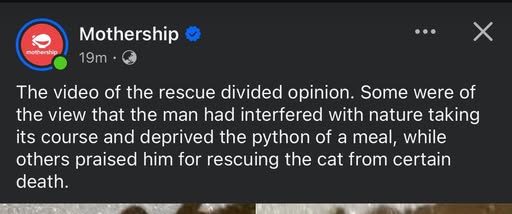
I agree it’s funny, but also, I was like, really? A cat was being eaten alive. What if it’s a small dog? Would even more nitpicks online complain that the rescuer has deprived the poor python of some nice fresh dog meat? I viewed the same Facebook post, and man, if you think there’s lots of retards on X/Twitter, there are millions more, some even more wild and deranged, in a larger platform like Facebook. Look, no one died. The cat ran back somewhere, the python slithered away, the man moved on with a video post in his pocket. And also, it’s animals. Which of them deserves saving by humans in the savage nature, then? What if that cat was being savaged by a feral dog – both are animals, would the same nitpick be made by these treehuggers? Their “sympathetic” comments don’t stand to scrutiny.
AI prompt for the post image:
Create for me a collage-style image – a collection of fictional social media posts, each portraying a certain topic. Strictly stick to using these topics:
- luxury cars
- small cats
- bubble tea store
- software auto-updates
- Filipino jeepneys
- someone using a cellphone
- old technology
- someone looking at a billboard
- newspaper featuring tech items
- popular romance novels
- game store
- Southeast Asia malls
- finance podcast
- faux-style historical biopic
- do not use “real” 3D images, make them look like anime characters
- strictly stick to Facebook, X and Reddit in the renders
- goal is to make them look fictional, so steer clear of anything too realistic
- make these posts look like scattered Polaroid photos on a table, then make the view from the top of the table, looking down at all the cards at once. make sure they look scattered but still make them recognizable (try to keep 80-90% of them visible)
(used Grok for the AI generation)
 Briathrail // Albert 2MNG
Leave a comment