

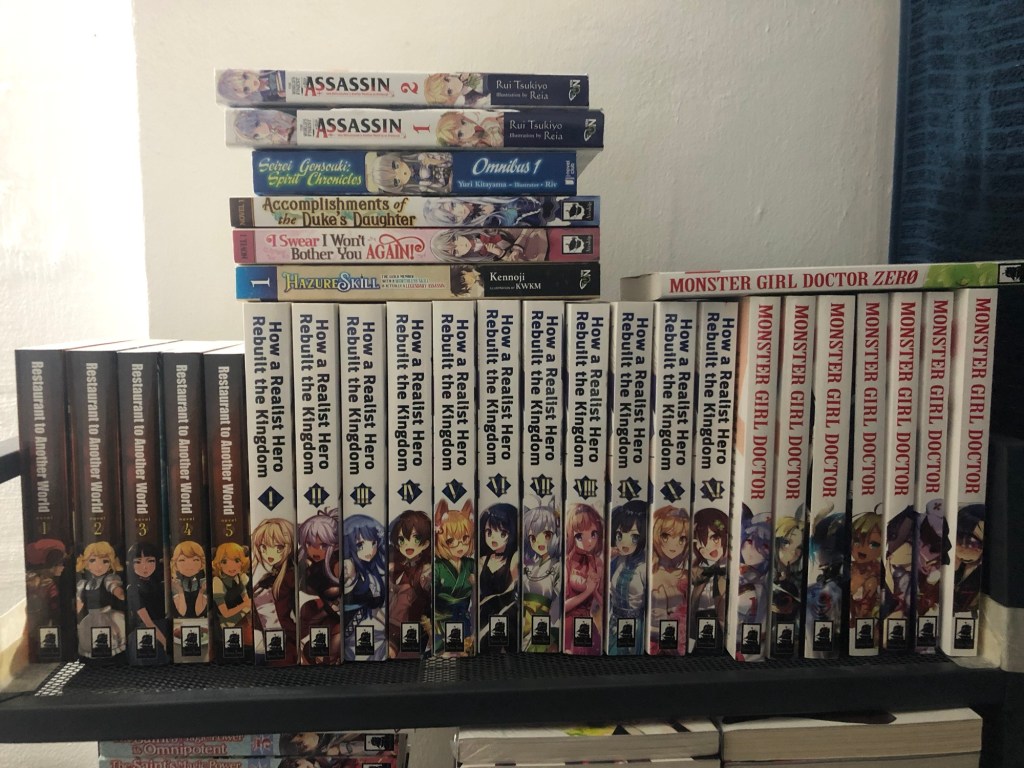
Let’s keep talking more in length of the isekai novels I like and recommend. Lots more I’d love to discuss longer, as each title has their own merits and flaws.
The Saint’s Magic is Omnipotent
This is one of my “most recommended” light novels because of how I personally liked it at first reading.
The novel stars a workaholic lady who was suddenly transported forcibly by magic to a medieval kingdom in need of a “saint” – one who would cure the kingdom of its ails against dark elements. Somehow there were two ladies summoned, and the person in charge decided arbitrarily that the other younger lady was their “saint” and left the protagonist to her own. And it just so happens the protagonist was really the “saint” they needed but the person in charge was an impulsive young prince. And so, she started to look for her own place in a fantasy RPG world foreign to her own. And eventually she was recognized as their true “saint”, and her life changes.
It somehow breaks my cardinal rule about overpowered protagonists but greatly offsets it with plausible need, which I liked about it. She had to be, as the kingdom that summoned her was in dire need of her magic in large capacities in the story, so I gladly overlooked the overpowering. Another rule of mine about an overpowered protagonist is that they should have plausible flaws, or else they’re just a god walking the lands. And in this novel, the lady protagonist is very much not a social person – she was a workaholic lab scientist – so her behind-the-scenes maneuverings and management were entirely in the hands of her newfound friends and love interest.
The author, like the one in Realist Hero, made attempts to make small detours while telling the main story (literally called “Behind the Scenes”), but they solved the small nit I had with the previous one by making them feel consequential to the story at large. It basically became either a small side story about the secondary characters maneuvering behind the scenes to explain some things in the main story, or a side story of a secondary character’s daily going-ons that at least feels part of the larger picture and might have payoffs later. Nothing boring about reading the side stories at all, honestly. The author made them compelling enough.
And in terms of otherworld building, the author decided on an RPG aspect (the characters all had the standard RPG “stats”) and they can pull up a private window of their stat summary for only them to see. For me, it was weird, but given it was a fantasy magic world, I guess that could be filed in the big “everything is magic” folder. And for me who watched the .hack series back in the day, this setting is no stranger.
The world in the novel can be divided into two so far – the places resembling European monarchy but employs Western sensibilities such as a modern labbed research facility, and that place resembling Chinese imperial dynasties but strangely also had some people resembling ancient Middle Eastern traders.
I’m still a bit miffed that Japanese isekai authors could not escape the tendency to write and craft mirror cultural places – like for example, an otherworld kingdom that behaves like an ancient Chinese imperial kingdom and have novel illustrations depicting their architecture and clothing to be essentially Chinese except by name. I guess it was hard for them to make all-original unique cultures and looks, so I won’t fiddle with that nit too long. Writing’s hard especially if corporate publishers want their workload to be faster. But my small nit about it is that specific things like the Chinese dynasties or the European medieval monarchies developed their distinctions like garment designs, hierarchy, and castle architecture based on how their cultures progressed over time to come up with those. The otherworlds, in my opinion, should’ve deviated from possibly imitating much of our world’s cultures, if even unintentionally. Because to me, that’s part of the appeal of a portal fantasy setting. They should be markedly different.
But still, the story’s very charming and cohesive enough for me to keep following and buying the volumes whenever I spot them. To me, it’s always “first impression should be good” and “positives outweighs the negatives” with these stories.
There’s also a manga and anime adaptation for this novel. I vastly prefer the manga over the anime, as the manga captured the charm and essence of the story over the anime adaptation. Come to think of it, I vastly prefer animes that is either original or has a source I’ve never read before. I always get disappointed when I’ve read the source material beforehand then I watch the anime hoping it at least does well and I often finish watching underwhelmed at how it got that way there.
Accomplishments of the Duke’s Daughter
This story is, in my opinion, an excellent, easy to pick up, and generally nice recommendation for a subgenre of the isekai novels: “gameworld reincarnation”. In this subgenre, the protagonist/s get transported into a digital game that either they were familar with or they had awareness of, but instead of playing it, they get to live in it as if it was an actual fantasy world, either as a major player or a NPC, and possibly change the game’s outcome different from what the game originally was set on. Basically a “digital gameworld made real”. I’ll talk later about the more famous novel of this subgenre, but this one I’d discuss first for later comparison.
Some people might ask, is it the same as “Sword Art Online” or the “.hack” games’ stories? Not really, IMO. For one, SAO and .hack started as people in our world virtually inhabiting an online game over the internet. SAO’s virtual reality while .hack is an MMORPG. Gameworld isekai is not internet-based, it basically transports a human’s soul and knowledge to a world from a game and interacts with it like how a real world should instead of a game to play.
In this novel, the protagonist is a Japanese office lady gets into a horrific traffic accident (different from the truck-kun thing), passes out and wakes up afterwards in the body of the antagonist of the otome game she was playing before the accident, and in a pivotal moment in the game no less. She immediately tries to change her destiny right away, as the time and situation of her reincarnation left her little time to plan much, and people all know what happens to the bitchy antagonists in otome games (yes, I played a couple of them). Blessed with the retention of her extensive knowledge of modern concepts like business, marketing and banking (again, like in Hachinan before, I assume she worked at a major Japanese conglomerate or one of the big 4 zaibatsu), not to mention knowledge of some foods and amenities, she was able to extricate herself out of the predetermined game outcome. But soon enough, her talents got her in a bigger, more convoluted political mess.
This novel’s story has a stark difference with the previous novel I mentioned, “The Saint’s Magic is Omnipotent”, which also has some elements commonly found in gaming, such as RPG stats. That novel had the protagonist physically summoned in a world that happened to have RPG elements that the denizens treated like it was some magic. No mention from the protagonist that she knew that world in any way or that she was in some existing game. No predetermined outcomes. This novel, however, is an explicit, no-doubts gaming world. The protagonist’s soul and memories merged with the supposed antagonist of an otome game she fully knew was a game, and she fully knew what the end game was, and worked to reverse it. So for me, “gameworld reincarnation” requires an explicit acknowledgement that the protagonist has inhabited a known gameworld.
But for me, this is an excellent recommendation for people who are interested in this kind of isekai – the story immediately ditches the “oh this is a gameworld” mindset right away when it was convenient to do so, and transitioned seamlessly to having the story’s progression be its own thing. By the second volume comes along, you’d think this was an original otherworld from the start instead of a gameworld. Sometimes the novel throws in a “this is a gameworld” reference here or there in service of a narrative, but largely by then the story stands out already with no trace of a “this is a gameworld” crutch. That’s good editorial work IMO. The writer also deserve big credit to just use the gameworld concept as a plot mover/convenience instead of becoming a limiting factor. A stepping block instead of a wall.
Like the other novels I mentioned previously, the author also incorporated some things from our world and put in a kingdom inhabited by people that dress and look like Middle Eastern people. However, I’d exempt this subgenre from my “lazy worldbuilding” criticism. It’s a gameworld. It’s a game made in our era, created by one of us. So naturally, many elements will appear that resembles much of what we have in our world over there, both historical and current. Of course, I’d always prefer a “brand new world”, but as this subgenre tackles a supposedly existing digital gaming software made real, it has good leeway to use elements from our world.
But when it comes to the protagonist, the author rightfully makes her actions and decisions be front and center, affecting everything and making them very effective without distorting belief. For one, her introduction of a rough banking system was interesting to read how she managed to do so.
And it touches upon something I like very much with isekai protagonists that I’d like to expand on – they almost always try to bring some comfort or convenience from our world into the otherworld. Almost always.
- In Hachinan the protagonist is a foodie, so most of the things he liked to spring out were based on his desire to eat well.
- In Restaurant where the otherworld concept is in reverse, the otherworlders always try to recreate the flavors they loved in the chef’s restaurant – be it whisky, pound cake, pasta – and one lucky chap managed to smuggle out Earth potatoes and made an empire out of it.
- In Realist Hero the protagonist was more of a managerial strategist but had enough aptitude to introduce some food techniques and flavors from our world to his kingdom.
- In Saint’s Magic the lady knows a lot of food from self-cooking and introduces dishes and flavors to a kingdom that seemingly had a bland English palate.
- And in this novel, the protagonist discovers a familiar ingredient she could exploit and turn into a marketable product, as well as remaking comfort items like hair products and herbal teas.
I get it, it closely follows our own history and proclivity of comfort. Whenever someone pitches tent in another distinct country, for example a European stationed in Malaysia, eventually that person will seek out to recreate the flavors of their homeland. And sometimes they end up opening shop and selling food or spices to share their cuisine and flavors. I remember when a Greek expat opened a Mediterranean restaurant that I frequented along the way to my workplace in Makati (and often went out of my way to eat at) because the food was foreign and delicious to me. Later the owner started selling jars of tahini, bite-sized pieces of baklava, and takeaway hummus. And also, our world’s sheer number of Chinatowns as well – people know it’s the place for legit Chinese food.
So far for the length, I always suggest this novel as there are currently less than 10 English translated volumes out there, but I personally would vouch for reading only up to Volume 5, as that wrapped up the story of the protagonist neatly. Volume 6 onwards are prequel stories about the protagonist’s otherworld mother, with small morsels near the end about the protagonist. I had little to no interest about those later volumes as they are no longer isekai anymore.
The World’s Finest Assassin Gets Reincarnated In Another World As An Aristocrat
This one, in my opinion, is the story in which I kind of ignored the first time I saw it, until I took a gamble on it and I got hooked somehow. Sometimes first impressions can fool you. Second shots can still be potent.
The novel stars an elderly assassin, who was promptly targeted for eradication by his employer after his last successful hit. Truth be told, this is the one whose death in the story made sense among all the isekai stories I’ve read so far. Assassin got backstabbed to clean up a track. But upon his death, his soul got “summoned” by a fickle goddess that offered him at another stab at life in another world in exchange for being a timed assassin – the goddess wants a certain “hero” to be killed at some point in the future, and she wants the “finest assassin” of his world to do so, in due time.
The elderly assassin agreed, and (par on course for most isekai) after choosing a few useful skills, was sent to be reborn to an otherworld’s noble house that happened to be a covert assassin house for a kingdom. It’s awfully convenient, but for the task given, I assume the goddess wouldn’t have skimped out and is inclined to arm him with the means to achieve his given goal.
With most isekai protagonists that possessed knowledge, this novel’s protagonist wielded our world’s knowledge as well. The only notable difference here was, he used his accrued knowledge as some “extra skill” that had him bypass some difficulties that would’ve presented themselves had he been with lesser knowledge or experience. And it made sense for him to have those knowledge, given his renown as an “elite” assassin. For example, he knew the underlying physics and mechanics of guns. He somehow knew chemistry, and has ample culinary skills. Would be strange if those skills are from a high school student, yes? But somehow fitting to be secondary skills of an assassin tasked to blend into shadows. And it kind of diverges from the usual “protagonist uses our world’s things in the otherworld” way. This novel’s protagonist does use some products from our world and makes it a product for the otherworld, but as a means to an end for him (mostly). Guns made for personal use. Cosmetic products used to pass a certain specific “test”. Stews used to supply himself with proper nutrition because he judged the otherworld’s dishes to not be as helpful. What I’m saying is, he utilized them for non-altruistic purposes.
So far, I have four volumes, and I’ll buy the others once Kinokuniya stocks them again. Story is progressing nicely, although my worry is that the author might’ve not planned this out far yet, and only mapped a basic story path from A to B without much plotting how to get there thru several volumes. That’s the feeling I got after volume 4. It’s like, “OK, the end goal is this, how do we go there with this material and that material and that plot and this plot…” and so on. Not in a bad way yet, I kind of like where the thing is going, but I do have uncertainties floating around because I really want this story to be good all the way.
And another thing – if you like harems with your isekai, this one got it. Last count I had was 4 ladies, still average. I kind of like it that each girl has a story and motivation to try to get the protagonist’s main attention. First one was the default (aka the “Mash Kyrielight” designation) and the first love, second one is the “close assistant” trope and the third one is the “pseudo semi bro-con” trope … for the last one, which I won’t elaborate further due to spoilers.
In terms of the protagonist moving along in the otherworld… seems a tiny bit strange that the father, a doctor as well as an accomplished assassin on his own, has not sensed his “son”’s unnatural aptitude, especially at assassination. There’s gifted and there’s “how the hell can you do that at your age” kind of incredulity that eluded the father. He probably folded it under “my son’s exceptionally gifted” and left it at that.
And also, on the subject of aristocracy in Japanese light novels – only one trope stands above all else and permeates all who dip as much as a pinky into that pond – the “haughty aristocratic noble” trope. This novel also has that, and I kind of wonder if the Japanese really viewed medieval European aristocrats as snobby people who are either “fat and bossy”, “thin and conniving”, “in a political cesspool of filthy rich snobs”, “rich enough to hold regular party buffets”, “unhealthily obsessed with succession and titles”, or “don fancy garments and dance in a ball”, something along those. It’s at the point where when I get to read Japanese-made stories and come across aristocracy/nobility, and I can predict where the story might go. If you’ve read a lot of stories involving the “nobles”, you’d get what I mean. It gets all same-y after the tenth one or so. And it’s sad but understandable.
Going back to the novel, so far after Volume 4 the story gets a bit interesting as far as the protagonist’s goals and newfound life and interests somewhat collide a bit and he has to navigate the balancing act – he started to care about his new life and loves, but at the same time his original goal and target is still firmly on the board. I doubt he is the type of guy that reneges on a signed deal. But it will be interesting, I think, when the decision points come to collect their answers. I know the published translations already has a Volume 5 and more, I’ll buy them later.
For the anime, it was passable, albeit with small comedic touches. The storyline barely diverges, the art looks great, and the dialogue were as expected. Good anime filler to watch as the main novel story lends itself well to episodic stop points too. The manga on the other hand… more comedy but also some stylistic choices were acquired tastes. And I kind of felt the story being less cohesive in the manga than in the anime. Strange feeling. If it came to that, I’d heartily recommend the anime for now.
… and this is getting lengthy again. I’ll have to trim it again here. I’ll have another set of isekai light novels later in another post.

 Briathrail // Albert 2MNG
Leave a comment