


“What if you were transported to a wholly different world – what would happen to you?”
That, to me, is the most basic premise of an otherworlder-themed story. A person from a world – often ours – transported into another world with different realities, cultures, languages and way of living.
It’s some sort of expanded travel fantasy too. Imagine traveling to a country that has a whole different vibe than yours. Say for example, Thailand. Not every tourist can read or fluently speak Phasa Thai. They love strong, bold, but nuanced and distinctly Thai flavors made possible by their abundance of spices and plants not commonly found in the West. After stepping out of the DMK airport, you’d feel like somehow this is a country different than yours – some aspects the same, but distinctly different nevertheless. And otherworlder stories take that piece of travel wonder and expand it – not just a nation inside the same world, but an entire existence, a new world different from your own. Escapism, in story form. Portal fantasy. To step into a new world bringing along the sensibilities of our world. And they all speak English there somehow. But later it got retconned by most authors/writers into “auto-translation” magic – protagonists suddenly gain the ability to talk and converse with otherworlders without much difficulty through auto-translation of what they say into something the others can recognize as their language.
And for me that longed for traveling outside my country back when I was a kid, this genre has captured my imagination. My family wasn’t too poor but my parents put all the resources into our schooling, so “international” vacations were off the table. So my travel dreams were mostly in my head, devouring novels and films, dreaming of travels to wonderful places.
The classic one that most people know is “The Wizard of Oz”. There’s also “The Neverending Story”, of which I really loved as a kid. One blockbuster series also had an otherworldly theme present in heavy strokes, the “Narnia” film franchise. You can also paint “Guardians of the Galaxy” as an otherworld story, as it’s about a kid who got kidnapped by aliens and spent much of his grown life travelling to “other” worlds.
It’s also why I am drawn to JRPGs so much as well – especially Square Enix’s. They do a good job (generally) with their stories that immerse players in to another world of fantasy. Whenever I play their games for a while, it always felt like I was inhabiting the game’s world itself. I get immersed, and spend months playing the hell out of it.
And when I became an office worker, I still dreamed of travel outside of the Philippines – and in 2017 I managed to cobble up enough savings (and some loans) to finance a week’s worth of travel. I went to the first place that in my mind was a fantastical land of wonder and foreign delights that I can access – Japan. I grew up watching those Japanese home videos showcasing positive videos of Japanese culture, and watched a lot of anime. So in my mind, it was the main place I should aim to have a good, long stay at. And I did enjoy it to the maximum extent I could. It was a foreign, strange and exotic world, but by the end of the week I felt I understood it way more than what I saw on YouTube and TV.
But I am still a booklover, so while my wanderlust can be satisified every year now (as I have some money), I still love to spend afternoons in bed with a good book in hand, reading of tales to faraway fantasy worlds. Thank heavens that Singapore has a very compentent supply of English-translated light novels (my current preference) with Books Kinokuniya bringing here the goods in English.
And I was made really happy, many years ago, maybe starting in early 10’s, that Japan had a boom of “isekai” (that’s the subterm for it) stories. Because before that, I only get to have portal fantasy stories (that I like) every once in a while. Like, one or two per year. Now it’s a few every season. There’s definitely a healthy appetite for them, and it shows – even some of the “hentai” that gets released in Japan has one or two otherworlder stories mixed in the release lot (don’t dig deeper).
But with increased volume comes a noticeable relaxation of standards. Think of it as a car company that shifted from small-time to big-time. When only a few hundred worked on the assembly line and the car is some specialty stuff, the car was sturdy and built well mostly by hand. When the company expands to thousands, gets publicly traded, and factories with automation started to pop up, some minor quality issues start to crop up because an increase in personnel does not mean the quality will always stay the same. Basically the gap between 80 and 90. Not big, but definitely noticeable. The tradeoff of output increase.
Same with the isekai, but just from a personal taste perspective. Lots of stories, but not all of them are to my “liking”. Publishers want to fill the demand as quickly as they can, as much as they can, to make shareholders happy. So I presume, based on the number of books and titles I always see in Kinokuniya’s light novel and manga sections, they take on any author and snap up lots of web novels for book deals. I couldn’t blame them for acting that way.
With that, I had to be very discerning with the books I buy. I never based it on popularity anymore ever since I bought the first volume of Mushoku Tensei because it was “popular”, and the opening chapter (including the backstory of the protagonist) wasn’t to my liking. First impression sucked big time too, like farting loudly on a date. So now I gravitate towards the ones whose premise, artwork and opening chapters had a good hook to them and were more aligned to my preferences. And it’s nice that Kinokuniya had some of the titles be an open read, so people like me can discern before buying a book or two.
These below are some of the better titles that I’m truly invested in following, because I truly like them and hope to read more:
Hachinan tte, Sore wa Nai Deshou!
This one I’m looking forward to having an English-translated book version, for I have only JP Vol 1 and 2 (bought in Tsutaya in Japan) and only follow it for now via fan translation. The story’s basically a salaryman (who probably died in his sleep) that woke up inhabiting the body of the young son of a poor knight house. It just so happened that he was blessed somehow with loads of magic power. And he somehow knew the production methods for a lot of our world’s sauces and condiments because of his previous life’s line of work (I guess he worked at a major Japanese conglomerate or a top-4 zaibatsu).
Given that it started as a Shousetsuka web novel, there were a lot of wrinkles at the beginning that even the early fan translations tried to correct some of it. And when later on when the fan translators got hold of the officially translated books, it was clear to me that the early small nits were due to a lack of editorial guidance. Some storylines and characters were laid out better in the published version.
I do have a soft spot for this novel for a specific reason: during a lull at work in July 2017, I was comparing the Shousetsuka work and the fan translated work that were based on the imprints, and I realized 1) a few things got cut out of the web novel version, 2) some nuance in the web novel version made the imprint version a little better if it was “incorporated”, and 3) the book illustrations were left untranslated.
So I dedicated weeks during work to make a few “volumes” that I could read offline on the bus.
I based them on the imprint versions’ book length and chapters. I got hold of the raws, used Google Translate and other Japanese translation sites to get a consistent readable translation, and I combined some things from both the web and printed novel versions. I never did as-is machine translation – I employed context clues as to what the text was in Japanese first, word for word, and made best-I-could decisions on what translation to use and how it made sense to read in English. Some Japanese phrases did elude the online translating sites, so I did my research on those phrases and made editorial decisions on how best to translate them. I owed that editorial skill on my past experience as a school paper journalist back in high school, I ended up as an associate editor by my senior year. I translated the imprint’s illustrations to the best I could and used Photoshop to make the translated text’s placement look nice (except for the covers – I left them as is). Some characters’ romaji I had to cross-check and try to make sense of using phonetics and Hepburn romanization (had to read that one up a lot to learn a bit). I ended up with 6 PDFs that I was very satisfied with.
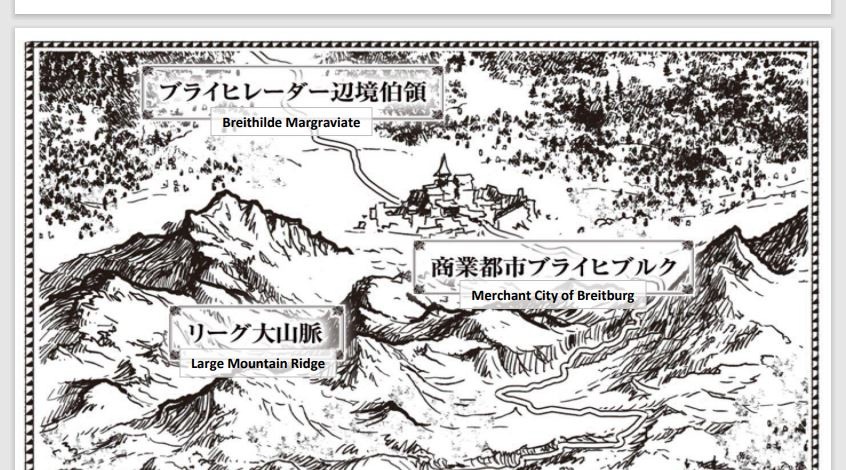
As with most things I love, I am also keenly aware of the author’s quirks and flaws. For one, the terrible balancing of the protagonist’s power and knowhow basically made the story’s power figures be not so powerful in terms of reining in the protagonist. The story had a monarchy, sure, but the protagonist, while being an “earl” by later volumes, is arguably three times more valuable and influential than the entire monarchy he is supposed to be under. At least the author stopped short of making the protagonist a god.
Second, the author has a predilection towards incorporating our world’s elements into his fantasy world as if it naturally existed there before the protagonist discovered them. I’ll discuss this stuff in length later in the other titles, but this novel’s flaw is unique compared to the others. Like for example, the “Mizuho” place was clearly Japan. It takes away from the portal fantasy setup a lot when the author liberally used Japanese names for a fictional place that implausibly could have named their things exactly the same as the Japanese did. Lazy writing there, obviously. And then the “Zontark” place was clearly a take on a modernized first-world European country with some American mixed in. I was afraid when I first read the chapters talking about it, like “oh no is the author going full yeehaw howdy on this” but thank heavens it’s just a mixture of EU and America’s bureaucratic and idealist excesses.
Third, the author sometimes stumble into minor loopholes in logic and small leaps of implausibility. I highly doubted they were intentional, though. An expectation I have for most isekai stories I follow is that authors shouldn’t take their readers for granted – the stories, while steeped in fantasy and fiction, shouldn’t try to make unaccounted leaps. Like “oh I just happened to have this hammerspace thingamajig containing the exact Deus ex Machina item we need to beat this asshole” kind of ludicrous leap. Fortunately, this author does it minimally and maybe unintentionally IMO so the “leaps” were mostly only noticeable after secondary readings and attention to detail was exercised. First reading, OK. Second reading, uhh…. how did that happen?
But knowing these, I still love and follow this series. The author is still crafting a story I still want to read more of, and hopefully I get the English book imprints someday.
Don’t bother with the anime adaptation – it’s absolute dogwater IMO. The manga adaptation is passable, but it skips a LOT of the nuance that the light novel contains. But that’s the nature of the drawn art – some things get left off and some things are left to the readers’ interpretation.
Restaurant to Another World
This light novel is superb, as it employs a story pace that is to my liking. Bite-sized chapters about either food or some of the characters of the novel. Boatloads of charm. And it’s a nice take on the isekai too – instead of an Earth person transported to another world, it’s the denizens of another world visiting Earth thru a Japanese Western restaurant’s doors and sampling its menu of delicious meals both Western and Japanese. There’s five English print volumes so far (a sixth one maybe this year), so if I have to recommend an isekai novel for first-time readers, I’d always give this one first. No rush to read all of it in one sitting, too.
Basically the gist of the story went like this – someone from a foreign world stumbles upon a magical door, goes in, and discovers a restaurant serving delicious food for any kind of customer. The door only appears once every seven days (they called it the “Day of Satur” – maybe because the first restaurant chef used the word Saturday to describe that day, or the author just used it without consideration, perhaps), the amount to pay is reasonably cheap, and the clientele ranges from rowdy kids to fairies to human-form legendary god dragons. No violence allowed inside the restaurant too, and if they try to do something stupid, the door simply never lets them touch it anymore after they exit. The novel starts with the grandson of the original chef, and he employs two otherworlder waitresses – one with demon horns, and later, one legendary dragon masquerading as an semi-gothic elf. The restaurant’s door has the magical ability to connect Earth to that other world. The chef doesn’t have any overpowered super stuff, but he’s a pretty competent chef in his own right and can whip up dishes depending on who’s the customer at the moment.
As with earlier, I do love this light novel for its easiness to just pick up and read through. No complicated stuff. Food talk is relatable too. But I also have one specific small nit – vague finances. The otherworlders paid for the restaurant’s meals with their currency – be it gold coins, silver coins, elf coins, treasure chest coins – and the chef collects them every month to both pay his demon waitress (the dragon waitress is paid in chicken curry, spoilers I’m sorry) and to pay the rest to an otherworlder trader for a bag of otherworldly meats and ingredients to adjust his palate and cooking to his foreign guests. He buys the bulk of the ingredients on Earth. The only conclusion I can think of is that the restaurant must be doing extremely well on weekdays for the pure profits to partially finance a full Saturday private restaurant operation. I couldn’t think of a reason for seeing him trading the gold and silver coins to an Earth jeweller, that’s a hornet’s nest of troubles for traceable money.
Another much smaller nit I’m picking off is that the author is starting to expand the novel’s otherworld, and I can keenly sense that he’s looking how to tie in the restaurant food theme into the world he is trying to present, and some chapters in and beyond Volume 4 has started to stretch thin a bit, but not close to a worrisome extent. I consider Volumes 1-3 to be very good in terms of pacing, narrative and content.
And also, the author wasn’t immune to story population shortcuts, this resulted in the insertion of several cultures that closely mirrored our world’s cultures, like feudal Japanese samurai and medieval European monarchies (again), but at least the author managed to craft some distinct cultures for the monsterfolk. I shudder to think what if the editor greenlighted a tribe of lizardfolk living like Brazilians or something.
I don’t want to delve into spoiler-y stuff, but this one I expect people to take up easily and want more beyond Volume 5, like me. It’s a good starter isekai novel for all ages. No muss, no fuss, and no difficult starter concepts to grapple with (“this sword is special because a goddess bestowed this to the hero blah blah blah blah”). Foodies should like this light novel as well.
This novel also received an anime adaptation – and ran for 2 seasons. The anime is, well, fine, I guess. No egregious crimes committed. Watched it on Netflix and it’s a safe anime. As the anime ran into the “GoT wall” (the HBO live adaptation ran out of material because GRRM hasn’t finished all the books yet), they went ahead with a crucial storyline expectation that the books haven’t even covered yet. I can’t blame them. So while I still can recommend to watch the anime adaptation, I suggest people treat the anime adaptation story and the source light novel separate for now.
The novel also received a manga version – a few volumes. The artwork’s nice but IMO I vastly prefer the light novel. I still bought them all because the artwork, again, is nice.
How a Realist Hero Rebuilt the Kingdom
This is also near the top in my list of isekai novels, although the current length of volumes might intimidate potential readers. Last I read was Volume 17. And the storyline hops from one main conflict to another. So I could only recommend this novel to a long-term reader.
But also, the novel, in my opinion, is something of an acquired taste for people with non-malleable political viewpoints, as the protagonist is more of an old-school liberal democratic person but is keenly aware of what can be improved and can adjust his morals to what is needed at the moment. But for people with an open and curious mind, the novel can be very interesting as to how the protagonist decides his kingdom’s direction with a realist’s view.
The novel is about a guy who was recently orphaned and suddenly summoned to a world in need of his talents. The kingdom’s king, who summoned him, immediately saw his potential and abdicated the throne in favor of him. Then began the changing of a kingdom from a decidedly medieval European monarchy to something more closer to the sensibility of a realistic person that came from our world’s modern Japan.
The author, in my viewpoint, seem to be well-versed in history as many of the otherworld kingdoms mirror either historical reigns or historical dealings of our world, but written and inserted in a way that still somehow fits in an otherworld with no cultural contact with this world. That makes me think the publisher assigned him a highly competent editor. That’s no easy feat.
As far as “portal fantasy” isekai goes, it bears all the traditional hallmarks – competent protagonist, sudden/forced summoning either by magic, reincarnation or soul migration, fantastical otherworld, either given or assigned a mission. And no, I will never go for truck-kun unless the story is some good shit. In my opinion, suicide or forced death without a good reason or background is just lazy premise writing. Just go for reincarnation, vehicular crashes, died in sleep, magic portal that pulls people in, died in hospital… those kinds. I really don’t go for a “protagonist died after being hit in the front by a truck like roadkill” novel, but I’m still flexible.
Like the others, the novel also suffers some small flaws – I’d like to emphasize, small. One, the author amiably tried to insert substories within his story, like little detours, but sadly they ended up either inconsequential to the larger picture or just book filler at best. I wished he had good payoffs for some of them. Second, evidently by the length of the entire novel by now, the author stacked the protagonist with far too many wives. It’s also a similar problem with Hachinan, but that novel’s author unwittingly gave the protagonist a plausible cover for having so many wives. In this novel, however, I find the “I’m a special case, destined for a greater purpose” a bit lacking in weight.
When it comes to cultures, at this point after following five or so light novels before this, I was already resigned to the not-so-hidden preference of many isekai authors to liberally use our world’s cultures, sprinkle salt and pepper on it, and call it an otherworld setting. This story basically starts in a medieval English monarchy setting. Some of the other kingdoms in this novel mirror other cultures and countries, from the Vatican to the “Mongol empire but more Chinese instead of Mongolian”.
If fantasy medieval monarchies mixed with modernization efforts and some political flair is your jam, you’d love this novel. I will still recommend it, but if you are intimidated by the volume count, you can get the eBook version. So far, I still like it enough in Volume 17 to keep buying the books. The author has set up his story to not be constrained by length or time. And that’s good – there are stories that are good for only a few volumes, and some that are good for twenty volumes. It highly depends on what world the characters are set up to be in.
This novel also received both anime and manga versions. The anime is passable, but I had that feeling of huge chunks of context being left off. That’s the curse of having read the source material first before seeing the adaptations. The manga version seemed hefty (the one in Kinokuniya bundled 2 volumes into one) and the art style… I’d say it’s also an acquired taste. It’s thick-lined, detailed, and women with insane gravity-defying bosoms. I’d say people should try reading it first before buying any. If you’ll dig the artwork, great. The story in the manga was just fine, I guess. The illustrations do the heavy lifting.
… and this is getting lengthy. My apologies. I’ll have to trim here. I’ll have a part 2 in a separate post.

 Briathrail // Albert 2MNG
Leave a comment